We’ve not posted for a while but we’ve still been busy – with wordsearches, puzzles and some creative writing too.
Here are a collection of the most recent poems written by guests. We hope you enjoy them!
It’s a stormy night
Waiting for daybreak
Inside my new mind
(by J)
Lost Lullaby
When I’m lost with no one else
I need a place to be myself
A place where it’s simply okay to be
Homelessness
Sleeplessness
Distressed and restless
Four walls
A ceiling above the floor
Maybe a window and a door
In this crowded world
Is there any room for me?
What a life it would be for me
Sitting at home watching TV
Making cups of tea staying in bed till three
Luxury
Good night
Sleep tight
Turn out the light
Good night
Sleep tight
Turn out the light
(by J)
Sky for ceiling
Trees for walls
Birdsong my alarm
On good days
Owl hoots my lullaby
(Anon)
Where is normal?
So where are you really from?
The cemetery or the crematorium?
Well where are you normally from?
I don’t know where is normal
Where it normally is
I never know where normal is
Until it isn’t
And by then it’s too late
You know
Where is normal?
And why
Is it always
Less than normal
And more than usual
And what time is it
Eeleven eleven, or eleven eeleven
Eleven eleven eeleven eeleven
Eleven eleven …………eeleven
(by J)
Autumn colours
Rushing by as the train rolls on
Gloucester Cathedral
Pinnacles disappearing in the mist
Mistletoe in clumps
Amid silhouetted trees
And at night
Two foxes play
Among the swings and
Roundabouts
In the children’s play area
We are not alone
(by J)
Letting Go
Holding, tightly, fists encase
the overwhelming feelings
churning, twisting a cruel embrace
the overstimulation, reeling
Relax, unfold each tiny fibre,
softening my grip
empty my pockets of despair
Allowing, trusting I won’t slip
Into the forest I bravely venture
searching, exploring freely
Nothing here I’ve seen before
Opening, inviting, letting go to be me
(by CS)
Creative journalling
Today there is a blank page
up against an unfocused mess
before drawing the shades
or the feeling fades
write it out,
check it out,
chuck it out,
or change it.
Drawing a line
through that mess,
a line, a boundary
and what follows
today is up to me
a responsibility, or a gift.
And that’s my lifeline
(by J)
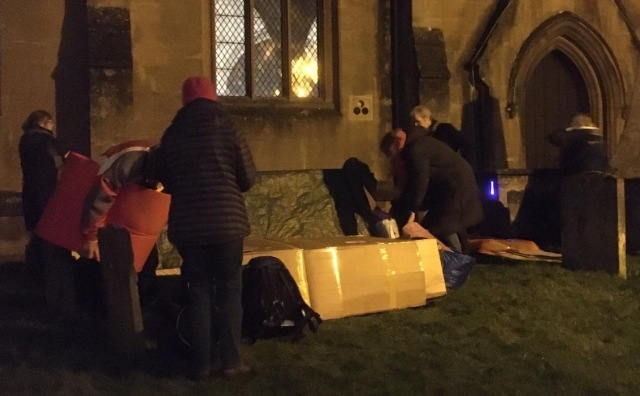
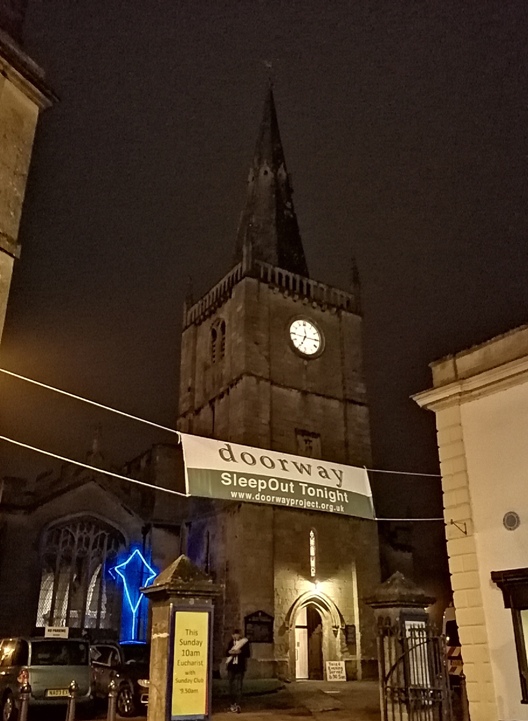
On the night of Saturday January 25th, the latest (8th) biennial Sponsored Doorway SleepOut took place in the churchyard of St Andrew’s Church, Chippenham, venue for the SleepOuts since 2012.
The SleepOuts are major events for Doorway, for raising awareness of homelessness and of the Doorway organisation, but they are also a major part of our income stream – we are after all a small, independent local charity, with no central or council funding. SleepOuts are sometimes criticised for doing more for the conscience of the participants than about ending homelessness. We stand by ours. As Doorway’s then-CEO Lisa Lewis said in ‘The Pavement’ magazine in 2010 “Sleep-outs are a very effective means of gaining both media and public attention to highlight the fact that homelessness exists at all in rural areas. We can raise awareness and then go on to educate the public in the issues surrounding homelessness on all levels. We use rough sleeping as a starting point.”
As Jo Kitching, Director of Doorway since last year said in her speech at the start of this year’s event, things are different in our rural area: “……. The thing about rural homelessness is that you can’t always see it. People end up sleeping in their vans, their cars, and fields and woodlands, so it’s not always apparent. … Homelessness isn’t only about sleeping rough, it’s also about people who just don’t have their own front doors, sleeping on sofas, sharing bedrooms, sleeping on landings or sitting room floors . .. ”
“We need also to change attitudes sometimes. It’s quite easy to dismiss someone who finds themselves in difficulties, on the streets, or not able to keep their own tenancy, but it can happen really easily, it could happen to anybody in this room. It can happen for all sorts of reasons, it could be loss of job, addiction to gambling or drugs or alcohol, it can be breakdown of relationships or it can be because of mental health problems. It could also be completely from no fault at all, being evicted from a private tenancy for no good reason.”
“So Doorway is here to pick up the pieces and to get people back on the right path, and to show non-judgmental support. We provide great food, hot showers, laundry, a football project and loads of other things, as well as signposting and referrals. We do it without preaching and without judgment.”
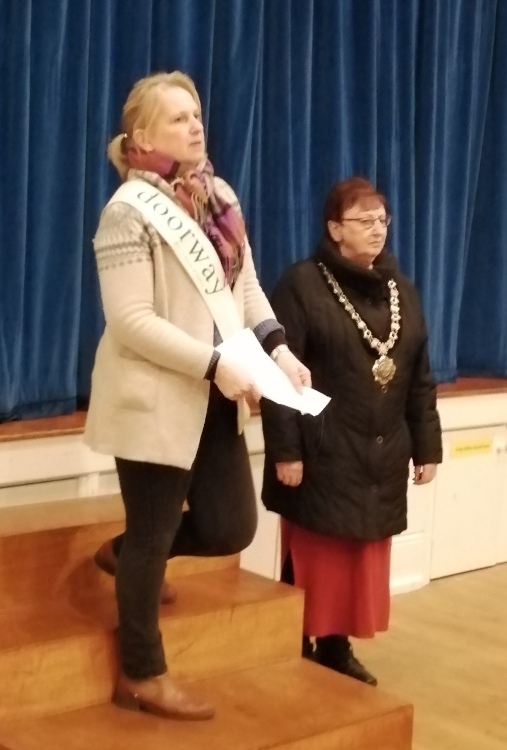
Doorway Director Jo Kitching, with Chippenham Mayor Desna Allen.
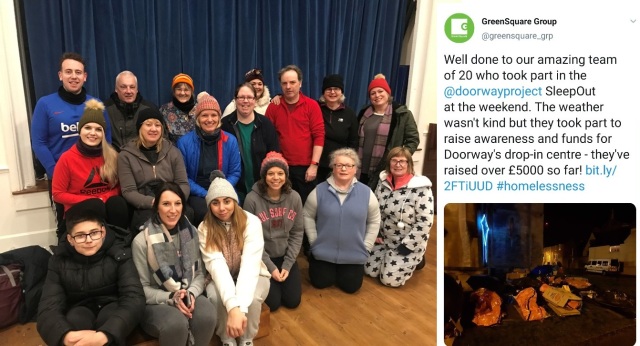
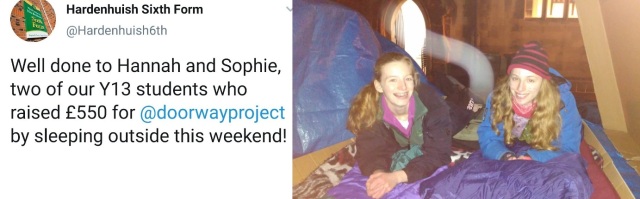
This year saw a record 49 ‘sleepers’ , a new record (previously held by the 42 in 2008) and at the time of posting the total raised is well above the £19,000 mark. A special mention here to the 20-strong team (yes, TWENTY) from GreenSquare , who have raised more than £6000 of that; and to extraordinary primary schoolboy Alfie, who raised £1500 through the Sleep Out and by baking cakes. With Hannah and Sophie from Hardenhuish School raising £350 as well, we can see that the younger generations are capable of huge amounts of caring and practical action.
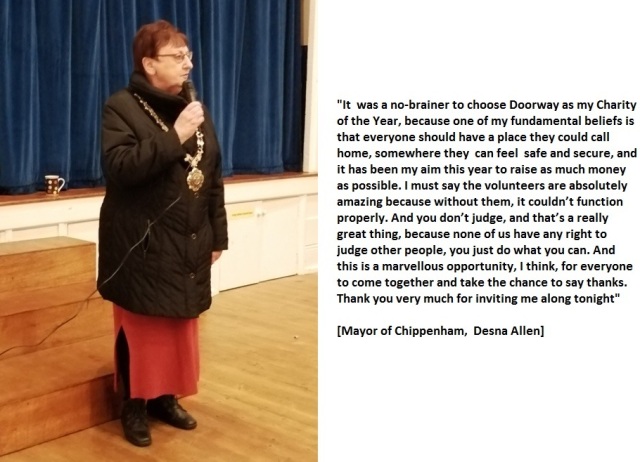
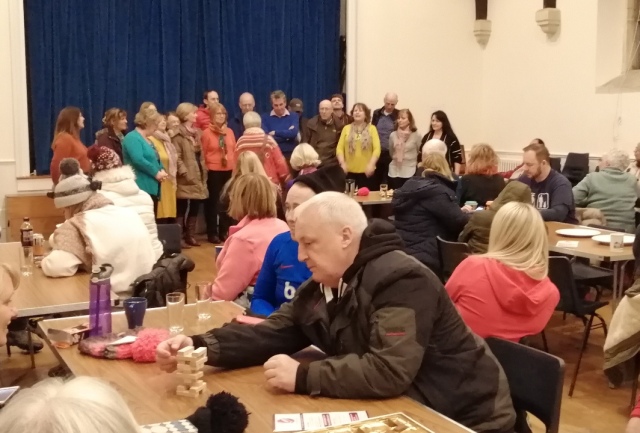
The event started with short speeches by Chippenham Town Mayor Desna Allen and by Doorway’s Director, Jo Kitching. There was then, for those who wished to attend, a service in the church, Our old friends Lingmara world music choir sang at the service. They sung more songs after the service while the sleepers ate and had hot drinks. Sadly, BBC Antiques Roadshow’s Marc Allum was unwell and therefore unable to read the traditional bedtime ghost story.
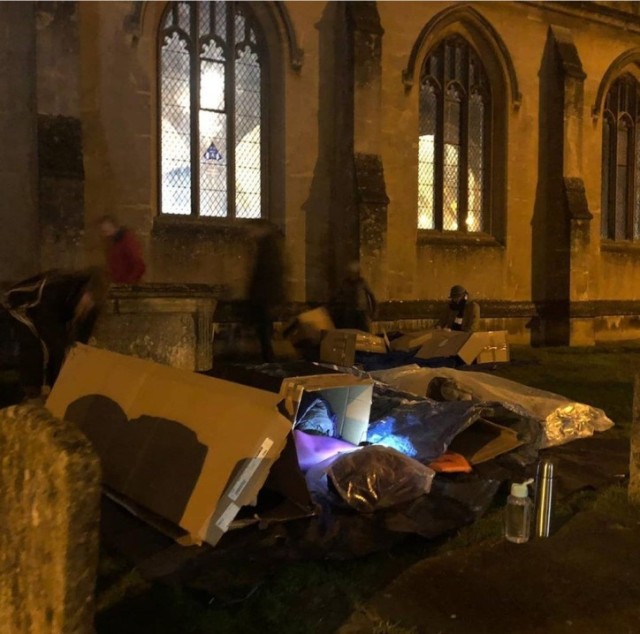
Then it was time for the ‘sleepers’ to settle down in their combinations of cardboard boxes, sleeping bags, tarpaulins and bits of plastic, with help for those that needed it from our military volunteers. There were no ‘alarums or excursions’, and the weather was fairly kind, being fairly mild for January and mostly being a fine mizzle. However, at 05:00, the skies opened, and there was a mass arising, with most sleepers woken rudely and rushing for cover, in scenes somewhat reminiscent of a zombie film. Sadly I didn’t manage to capture any of that on camera as I was rushing for cover myself!
Undoubtedly, the event was a great success again. Some words and images from the night:
Lingmara sing in the Hall to ‘those about to sleep’
The GreenSquare team before and during the SleepOut
“What Jo has tried to organise is a very good thing, trying to create the awareness so that people see these people, they can try to help one way or another. To create awareness that there will be circumstances, reasons why somebody is sleeping rough, and they are loved and they are not alone in this world. People should show love to these people – it could happen to any of us”
“It was in a good cause, and it was a pleasure to do it, and you’re surrounded by workmates, colleagues, friends. It’s been really interesting, and the weather wasn’t bad. I think it does give you the insight into what it’s like to sleep outside, and though of course we can all go back to our houses this morning, it does show you it’s not a great experience. [What was the worst experience?] Not getting enough sleep. And being cold, and you can’t get comfortable, no matter what. And when you start getting cold, you can’t get warm, no matter what.”
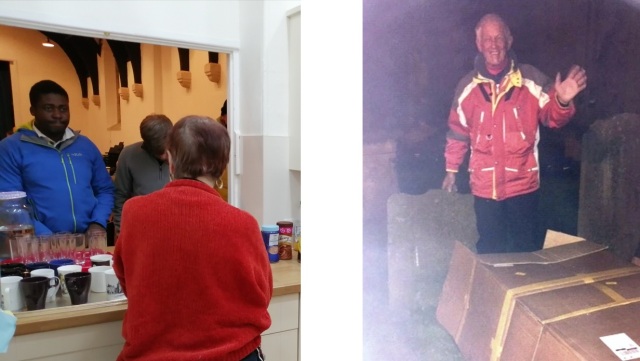
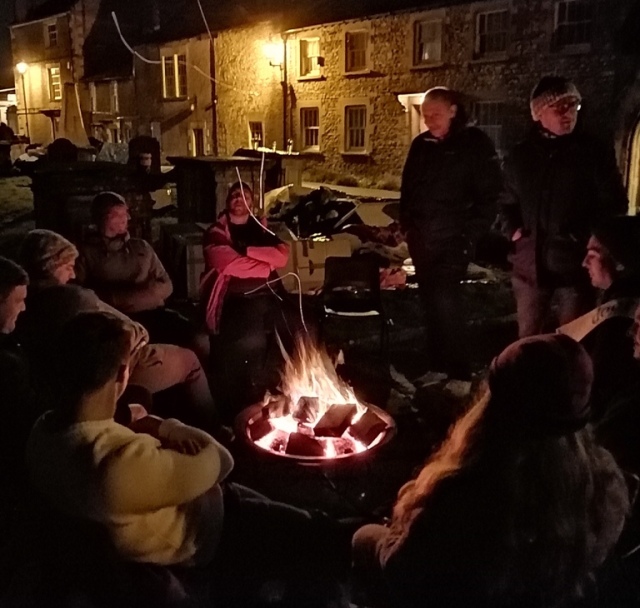
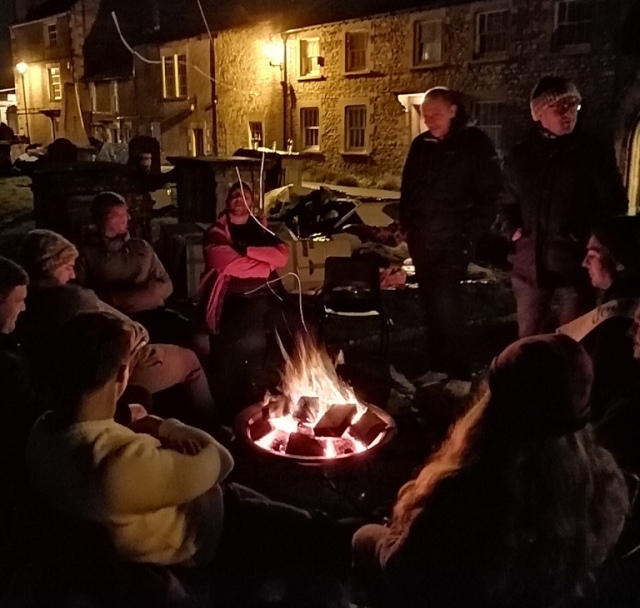
Fuelling up with hot drinks – then bedding down for the night
“I knew from living in London that homelessness is a massive issue but it really brought home to me how it’s affecting other parts of the country. I think it’s really important that we raise awareness of these people as quite a lot of the time they have a stereotype and they are all painted in a light that is negative. I think it’s really unfair and I think it’s really important that we support them, help them get a better way of life, and support them getting a home and a safe space.” [Some people think sleepouts are middle class ways of virtue-signalling. What do you say to that?] “Each to their own if they want to think that, but my smug middle class night outside means I’m still getting into their brains somehow. I think it’s doing your bit, it’s raising awareness. I think the type of people who say that, they’re not going to be the people that help in the long run, so I’d ignore all their comments and think it’s important we do our bit.”
“I’ve been close to being homeless. It took three missed payments on my rent and I was issued with a notice. It’s very easy to end up there. It’s a scary thing. So something like this is a godsend for people who are out there.”
“Once I got to sleep, I slept better than I thought I was going to. But what it’s really brought home to me is if the weather’s bad. It’s just the rain, the noise, the worry about your stuff. And if you haven’t got a tarpaulin, and rain soaks into your cardboard box, that banishes all thought of sleep. To think that maybe all your possessions are going to be unusable or uncomfortable that must be pretty hard to bear. We can all go home and have showers and dry our stuff out, but if you’ve just got to drag all your wet stuff with you all day, it must just be terrible. It’s really brought it home to me.”
“It went very well. But then I found myself lying there thinking “I’m swimming in water here!” There’s no point staying out getting soaked to the skin, is there?”
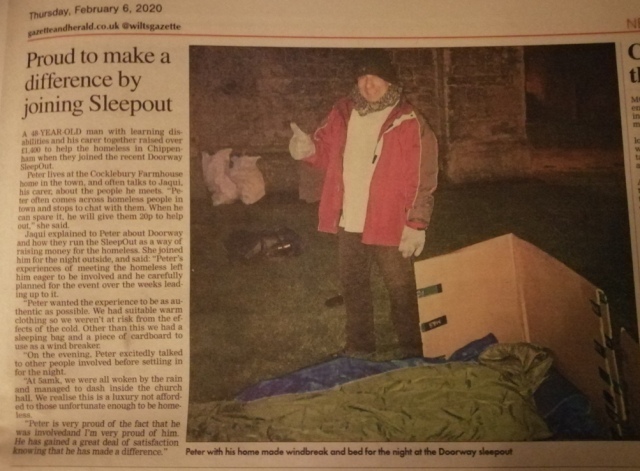
From the Wiltshire Gazette and Herald
“Apart from when the bells kept going off throughout the night, Pete loved it, but he actually thought we hadn’t succeeded, because we came in here and it’s not six o’clock.”[Oh no, as far as anyone is concerned, that sleep out finished when the rain came, so as far as we’re concerned, you’ve done it. If you were really rough sleeping, you’d have got out of there as soon as the rain came, you just wouldn’t have had a nice warm place to go into] “So you should be really proud of yourself.” [Pete]: “Every bit goes towards their situation.”
From Twitter
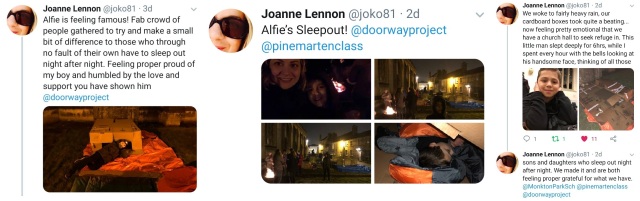
Alfie – the youngest ‘sleeper’ and probably the best known!
“I got involved because of Alfie. He’s been wanting to do things for the homeless for a long time, and he’s raised so much money – over £1500. He and his mum mentioned it so I said ”oh, I’ll do that.” [So in the morning you can blame him] “Yes, we’re all blaming Alfie!”
[Alfie] “I want to make money for Doorway so they can help homeless people. They give homeless people food, activities and shelter.” [Mum, Jo] “Last weekend, when I was getting a bit stressed about how cold it was, Alfie said “well think of the people who are out there this weekend, and it isn’t their choice”. So he started making me feel a little bit guilty. Alfie had his target, and at Christmas he was almost double that target, so then we increased it again.”
[In the morning] [Alfie] “It was good. I slept six hours. I didn’t like it when it was raining.”
[Jo] “I’m feeling very emotional. I just feel so lucky we can come in here. You can come in here and have a cup of tea, and it’s done, isn’t it, now? And that got me this morning, it really did. Because it’s been fine, but then waking up to that rain this morning, and then you just think “these people are going to be so wet” – wet all day, can’t go anywhere, horrid.”
“It does make you appreciate how vulnerable it is being out on the streets. Because we were protected, there was a group of us, felt safe, didn’t have any concerns, but thought “crikey, if you were on your own, where would you sleep?”. And we’ve all got a nice warm hall to come into if we need to. It was a really humbling experience, actually. I wouldn’t want to do it every night”
Two final interviews. One with our Director, Jo Kitching, and then the words of one of Doorway’s current guests:
[What are your aims for the Sleepout?]
“To remind the local community that homelessness is an issue that can’t be ignored, and it’s one that we still need to talk about a bit more to make sure people really understand why people either become homeless or at risk of losing their home, or find it difficult to find a suitable place to live. There are all sorts of complicated reasons for that, and the more that we do publicly talk about it, the better the understanding is, and that can only have a positive effect on the individuals involved, who once they hear directly from someone who is homeless, or has been, attitudes will change. They will see that ‘normal people’, it could happen to you, it could happen to me, it could happen to anybody. In a pretty quick time frame. You only need to have the image of it looming in the distance to think “wow, that’s scary”.”
[This has been the first SleepOut you have organised – what have been the biggest challenges?]
“I think probably just the fact that I haven’t done it before, so I didn’t have anything to refer to, I had no mind’s eye, no picture in my head. Obviously I was able to talk to people about what their experience had been, and looked at some photos, and obviously that helped. People were as generous with their time and advice as I expected they would be, because generally people around Doorway are generous with their time and support. So I’ve found it a lot easier than it could have been because of the people. And because Doorway has such a great reputation locally, people have been falling over themselves to help. My biggest fear was that it wouldn’t be successful financially.”
[You’ve already partly answered this, but what are your parameters by which you will define success?]
“The first definition of success for me is that nothing goes catastrophically wrong – and we haven’t got through the night yet! Beyond that, it’s generating interest in it, which I think we’ve done this year,good media coverage so far, should get a bit more next week, and hopefully that will only get better. When I was walking around today in the daylight, picking up dog poo in the churchyard, I met a couple of people, individuals, who asked me what I was doing, but they both knew about the Doorway Sleepout, though they didn’t know it was happening tonight. So that’s good that we’ve kept up the recognition that it’s a regular thing.”
“Another measure of success is the number of people we get and the number that was signed up was a great number, and we have a good number who have actually turned up on the night, so we’re going to exceed the previous record number we had in 2018.”
“Of course, the other measure of success is the amount of money raised. That is a big pressure, as I already mentioned, and we’ve already raised more than last time with just the money raised through Virgin Giving.”
——————————————————————————————————————————– “I’ve used Doorway for quite a few years. It’s given me a purpose, it’s given me somebody to talk to, it’s given me shelter when I’ve needed it, food and things like that, a hot shower, and it’s really turned my life around. Two years ago, I was here doing this after living in a van. With help from Doorway, I’ve managed to turn my life around. I’ve got somewhere to live now, I’m looking at getting a more permanent place with the Council. I can’t say how grateful I am to Doorway. To put it into words, it’s been absolutely amazing, and you are still carrying on doing the amazing work that you do. It’s also great that you’re not turning anybody away, and that each time somebody walks though the door, you’re actually seeing a human being.. You know everybody by name, you make everybody feel welcome, and it comes across in what you say to people. To me, some of the most important words are ‘good morning’ and things like that. When you’re on the streets, sometimes you can go days without even speaking to somebody. It takes two seconds when you walk past to say ”hello mate, how are you?”, and that can make a difference in a person’s life. Without things like Doorway, where is somebody going to get that? [You can become invisible] and sometimes you don’t want to be seen, but if somebody walking past just acknowledges that you’re there, that can make a big difference.”
“When I first came to Chippenham, I didn’t know about things like Doorway. It wasn’t until I was sitting in a doorway and somebody said “are you coming for breakfast?”and I thought “wow!”. And that’s how I got introduced to Doorway, was by someone who was in my situation. It was such a thing feeling “somebody actually cares”. I felt like a human being again. And to look on everybody as human beings, what’s happening tonight is absolutely amazing. There are so many people from different backgrounds here. And they’ve probably all got a story, a downfall or whatever. You have got some people who will walk past and say “that will never be me”, and then you’ve got another group of people whowill go “that could be me” or “I know someone in that situation” and they will take a bit of time with you.”
“When it comes to begging and things like that, I have so many people say to me about giving money. The thing that I say is if you’ve got £5, you could give the £5 to one person, but with that £5 you could buy a loaf of bread, you can buy some cheese, you could make up a whole load of sandwiches, and you can give that out to 10 people. To me it’s not so much about the sandwich, it’s that you took your time, you took the time to say hello, see how they’re doing and everything else.”
“Whatever town, village, city, there are homeless people there. There are so many everywhere – everywhere we’ve got it. And you can say to that person in Chippenham, do you know about Doorway? And you can say to go down there. To me it’s not about giving the person money. I wasn’t fussed about money when I was on the streets, but what I was fussed about was someone to talk to I’ve been thinking over these last few weeks, about the things I really missed, and it was the human contact. But the other thing I really missed was a tap. Being able to turn a tap on and have that running water come out. Roughly 4 years ago or so, I was living in vans, I was living on the streets, and not being able to have a glass of water. I didn’t miss TV or anything like that.”
Montage of more pictures, with Lingmara music, on YouTube:
—————————————————————————————————————————————–
Many thanks from us to (in no particular order):
St Andrew’s Church and Parish Priest Rod Key for their kind hosting. St John Ambulance, as ever, present throughout the event, thankfully not needing to be deployed
The three soldiers (Cpl Johnstone, Cpl Persaud and Capt McIlwain) based at MoD Lyneham who helped with ‘bivvying’ and with overnight ‘sentry’ duties.
Mayor Desna Allen for her support and her words at the service (and for making Doorway her Mayoral Year Charity). Café India and Cousin Norman’s for food Chippenham Street Pastors for passing by to check on us during the night, as ever.
And of course all sleepers, volunteers, publicisers, financial contributors, and general supporters of the event.
—————————————————————————————————————————————–
Hope to see many of you again in 2022. Unless the best thing of all were to happen, and there were to be no more homelessness. Well, we can dream. Which is more than the rough sleepers can usually do much of. The SleepOut was for one night. There will be, unless our dreams come true, over 700 nights of rough sleeping until our next SleepOut, come rain, wind, snow, whatever. And in a more hostile environment than our well-supported and safe SleepOut bubble.
We’ve had our usual fun with crosswords and have tried out a variety of word puzzles including the ever-popular word searches. Guests have said that it’s good to keep their brains busy and that they find it therapeutic. That’s nice to hear. That’s why we do it, after all.
On National Poetry Day in October, we had a visitor (S) who wrote us a special poem and J has, of course, written us a poem for Christmas.
Happy Christmas then, everyone! We’ll be back in the New Year.
A poem by S:
It’s National Poetry Day today
And I’m going to have my say!
I don’t know yet, what to write about
Whether it will be a moan or a shout
But it will be a thing.
I’m visiting Doorway and
The food smells good
I’ve had a coffee and I should
Clear my cup away.
I can’t yet, because I’m writing
A poem for National Poetry Day.
Oooh, chocolate cake and custard.
My favourite. Why’s it so hard
To write when you want to?
Like when you were at school
And your mind went blank
The moment the teacher pointed to you
And your heart sank!
There’s a buzz of chatter in the room
Clinking from knives, forks, spoons.
Oooh, chocolate cake and custard.
My favourite.
Right, let’s get down to it,
And write a bit of poetry.
Can’t you see how hard it is?
Stop and think, don’t take the… mick.
I’ve got it, J said it.
There’s cabbages in the vase
Green and mauve in a jug of clear glass.
Variegated, my big word for today.
Well, I think I’ve had my say.
No moan or shout today
This is my poem for National Poetry Day!
A poem by J:
Help at Christmas
Was it the first Christmas
or the last
That brought you to your knees?
Tidings of comfort and joy
or hands frozen into lumps into stone
and that voice that doesn’t sound like your own
that keeps saying “maybe this is life as well!”
But I look forward to the Doorway party this Christmas
For people who might otherwise miss Christmas
helping hands that span
and find some joy in forgiving
hope for living
all the best and love to give
Tear up the cords of fear and oblivion
And return home from the pilgrimage of chaos
To the light of a brand-new morning.
Over the last few months our guests have been continuing to engage with the group crosswords and word searches, while also trying their hand at a new ‘word bubble puzzle’ which has proved popular. This new puzzle – which presents a challenge along the lines of “how many words (of at least three letters) can you make from these letters?” – has brought out a hidden competitive streak in a number of our guests. Who can find the most words? Who can find the most interesting words? An arrangement of the letters of our closest beach resort, for example, (Weston Super Mare) provided an intriguing selection of words including swarm, snare, remorse, mental, rupee, strop. Guests were subsequently encouraged to try putting these words into sentences or even a short story. Mental stimulation, fun with words, a distraction from day-to-day worries, plus some prompts for off-the-wall conversations and potential creative writing.
To close, here is a selection of J’s lovely poems.
Enjoy and have a great summer!
Stealing Time (by J)
In the forgotten city,
Where life is a dream,
And only the dream is real,
Though the shops are closed
There are open skies
Lost Vegas is how I feel.
Trolling the town,
For a Quality Street
And anything the seagulls have left
For a treat
Keep your head
Keep on your feet
A cup of tea
Life is sweet.
My head aches
With the return of sanity
My hands shake
“Welcome to gravity”
It’s the only thing you get for free
Everything else
Is a luxury.
Three lines and the truth
Needs not to be a haiku
Signed,
With love,
The Blues.
(By J)
Leisure (by J)
“There is a time for everything”
The procrastinator ruminates
And there was time:
Bleeding through the cracks in the walls
Life’s great mystery
Sifted through arteries of birdsong
Lifted the washing from the line
Gently turning breath into wind
Listening to the sound of the unfurling of leaves
And in the grand haze
Mosaic maze of brain
Lullabies, alibis
The Great Escape
The Great Excuse
A distant train horn
attuned
The fanfare of fate
The solstice of understanding
dissolved in the sunrise of love
And finally the poem J read at the Civic Sunday service – Doorway is the mayor’s nominated charity for the year.
FOR REBEKKA
All tomorrow’s hopes
And the joys of yesteryear
Swept up like autumn leaves and
Flung into a dustbin
Of despair.
The winters seem forever
While the summers soon were sent.
It was hard to sleep and wake to search
For where my life had went.
The streets were not paved with mercy
There was no path to that second chance
Just a park bench to reflect for a while
In an exhausted fearful trance.
Until I came to Doorway
Where I didn’t have to hide
Hot meals and the welcome was warm
We gathered inside while breakfasts were fried
Like castaways after a storm.
Music art and crafts or I could pick up a pen
Write a poem about it all.
If I’m having trouble getting back on my feet
Monday evenings we play football.
When life was a battle I couldn’t fight all alone.
Now I have a roof over my head, and a place to call home.
Thanks to Doorway
I’m seeing better days
Until one day
Homelessness
Will be
Erased.
We had another good session at our writing group this month. The crossword we were doing in a little group had some nice old-fashioned words in it which were pretty fun to talk about:
What on earth is a rumpus? Is it a problem if you make one?
Who ever says “that’s a nice frock you’re wearing”? And what do they mean?
Word searches on dog breeds and flower types worked well. With so many beautiful flowers popping up all around us, in gardens and parks and fields, there was plenty to chat about.
S excelled himself this month by doing both word searches, L took one home to finish off, N took the crossword home, and J – after patiently helping out with our group crossword – wrote us a brilliant poem (see below) and promised to send on a short story later.
Talkin Trojan Horse Blues (a poem by J)
I don’t care how much you feel
that Trojan horse well, it ain’t real
I couldn’t believe what he said to me
and just expected me to agree
so I replied…
Well, if it is all just a mirage
could I leave it in your garage?
so we hauled it down the road apiece
and didn’t encounter no police
Pretty tiring though…
And then, relieved the giant horse
was now safely behind the doors
we shook hands and the poor old chap
went upstairs and took a little nap.
That old horse was pleased
with his overnight pass,
And a bellyful of iron and brass,
and inside a bristling bearded multitude
of soldiers, waiting to intrude
pulling on Spartacus T-shirts
splashing on the Old Spice
… And then early the next day
He opened the bedroom windows wide
and saw ten thousand Greeks outside
that Trojan Horse brought me bad luck
Looks like the whole town is running amok…
He phoned the boss, said I’ll be late
The whole town is heading for a grisly fate
I’ve got to stay and hold my ground
or we will lose the whole town
Hello, are you still there?
The boss replied: well, you told me
The Trojan Horse is a fantasy
and now that you just changed your mind
how do I know you’re not just throwing me a line?
Come round next week
and explain yourself
I’m not happy!
We’ve had a good few contented word searchers these last couple of sessions – especially popular was the combined gapfill and wordsearch on different types of fish. There’s clearly no plaice that warms the sole like Doorway…
We’ve been working with a slightly easier crossword these last months (from the free Metro paper) which has proved more accessible though there are still just enough obscure clues to challenge our regular crossword fans. We experimented with putting the whole crossword out round the tables with the easiest clues circled as a suggested way in. D, who is (in his words) ‘not normally a crossword kind of guy’ worked at it really solidly one session, teaming up with some others and even deciding to take it home to finish it off. We can always rely on N to help out with the trickier clues. So hop-drying kilns are ‘oasts’ and mother-of-pearl is ‘nacre’ then. Thanks, N! And you can even live in a disused oast apparently. Sounds cool! Not that anyone here would be particularly choosy: after all, any roof is better than no roof!
We rounded one of our sessions off with a nice chat about English lessons at school – not the easiest subject, D reckoned, (probably about the hardest language there is, in fact, in terms of spelling) but he remembered his English teacher as the one teacher he’d particularly respected.
Finally, read on for another poetic treat from our wonderful J:
Under the Prow (a poem by J)
When the ship docked
in Copenhagen
We set off immediately in search
of the little mermaid
Behind the pastel coloured houses
on the harbour front
pacing the cobbled lanes
and the fish markets
She was nowhere to be seen
from the beach to the horizon
not even a glimpse!
Time was running out
we had to run back to the ship
We had just made it
but we had to ask.
The old fisherman
pushed back the peak of his cap
and pointed a weathered finger
and there was the mermaid
motionless, serene, almost directly beneath
the ship’s prow
Our search ended where we left it,
the tale ends where the tale begins.
On the quay!
Doorway Writing Group January/February 2019
Our last two sessions have seen a good number of guests keen to engage with the crossword and our chosen wordsearches – most recently on the themes of wild animals and dances – and we had a few nice chats as a result: comparing our awful dance skills and thinking about when we last saw/whether we have ever seen an otter, a water vole or a dormouse. Discussing animals soon took us on to literature. Who remembered Wind in the Willows or the dormouse in the teapot in Alice in Wonderland? Who had read the book (or seen the film of) Tarka the Otter?
None of these books is currently in our Doorway library but there have been some great additions to it recently: a lovely selection of pocket-sized versions of some of the classics and – for those happier with a larger font size – a number of large-print romantic stories, found lurking (with amorous intent?) on the Wilko’s charity bookshelf. There’s certainly plenty of choice now including some poetry, a collection of which was recently enjoyed by our resident poet, artist, lyricist, the multi-talented J. It’s heartwarming to be able to report that J himself has just been videoed reading one of his own (brilliant) poems ‘Winter’ for St Petroc’s in Cornwall as part of their public awareness campaign to end street homelessness. Incidentally ‘Winter’ also features in Doorway’s 2017 publication Come on Through, an anthology of poems and lyrics penned by the Writing Group.
Read on for yet another example of J’s wonderful poetic touch, his evocative and poignant poem Home-Time.
Home-Time (a poem by J)
How did we make it through
that dreadful wait for home time?
Staring out of the window
as the minutes blur into hours.
How did we survive the crush
and the jostling at the bus stop?
Chattering like starlings,
past the bullies lurking behind the school gates
The smell of fish paste sandwiches,
petrol fumes and dust.
Returning:
to a responsible adult,
family pet,
or children’s TV.
Hobbies, fashions and passions
pass the time until tea
Even now:
after the passage of years
and home time is over
without a blink of an eye
the child is wishing
in a world without wings
waiting to be free
at home time.
Here’s just a super-quick post to round off our year with the Doorway Writing Group. The last couple of sessions have been characterised by some lovely teamwork and solidarity, guests and volunteers grouping together to complete wordsearches and puzzle over crossword clues. This month’s wordsearch, based on familiar pantomimes, got us all remembering some fun anecdotes from the past. We’ve had some nice chats about reading and innovative ways to go about writing. And, of course, please read on for some poetic brilliance from our star writer J and a thought-provoking response to the Writing Group “leave your comment on a post-it” challenge from another of our guests (anon).
Merry Christmas from all of us at Doorway! See you in the New Year!
Making Waves (poem by J)
God made waves to teach the angels how to fly.
And then the homeless taught them how to land.
History breaks like waves
on the hillsides
Brain waves
and waves of music
and we are dancing
Swirling like autumn leaves
In a mysterious motion of waves.
Universal Credit
Is Universal Chaos
(lines by anon)
Doorway Drives Away the Blues (poem by J)
Al, Tom and Ray
Came to save the day
The people clapped and yelled hooray
We sat down and they taught us to play
Driving the blues away
Miriam, the bongo queen
She was not mean
Just lean and keen
At driving the blues away
As if the day could
not be gloomier
There’s warmth and humour with a tune
in the roomiere
And I would give a host of angel choirs
For another of those Doorway hours
Free-falling, London calling
Mustang Sally, Gasoline Alley
And sitting on the dock of the bay
Sitting on the dock of the bay
So if your dreams aren’t what you planned
You betcha they will understand
Pop some music on the stand
And we’re driving the blues away
Where does an English children’s author share letters with a mapmaker or a venomous snake cross paths with a river nymph? Well, where else but in the monthly Doorway Writing Group crossword? Alongside word searches on types of cake and wild birds, guests were challenged to list the months of the year in alphabetical order or encouraged to borrow a book from our little library. All to exercise the brain, stimulate our creativity or simply take our minds off the oppressive heat or the pressures of daily life.
We’ll be taking a little break for September but back with gusto in October. In the meantime, it’s a delight, as ever, to share one of J’s stunning poems – this one on a suitably summary theme.
Cockleshells and Bluebells (a poem by J)
Aurora wafts the summer’s plume
And the suburbs are again in bloom
Vibrant hues and fragrance sublime
Hip hip hoorah it’s summer-time.
It’s alright in blooming Westbury
Where the white horse prances light and fairy
Things are grey on the estuary
Our lives here are sedimentary
Sitting here we hide beneath the tides
And keep our beauty deep inside
Overlooked but not forlorn
We shimmer with colours of nacreous dawn
For in halcyon days and heavy weather
“A thing of beauty is a joy for ever.”
This month’s session was comparatively busy. A grand total of seven guests engaged with the word searches and a selection of the crossword clues. At the writing table, the topic of adult literacy classes came up and we discussed how fiendishly difficult the spelling system is in English. Three of us then went on to have an interesting conversation about languages which use different scripts e.g. Russian, Arabic and Mandarin Chinese.
To round off our session, J finished off a poem for us: read on and enjoy!
Till next time!
Blakehill Nature Reserve*(a poem by J)
The war is over
The wildlife returns,
Barrage balloons untethered
To the tune of a lark.
Sentry posts deserted
The fence post only
For the short-eared owl
And the gathering dark.
Amongst the criss-cross traces
of the old runways
hares sport, klaxons fade to corncrakes
and curlew
The war is over,
But the battle
for the survival of the species
goes on.
*Blakehill Farm is a nature reserve near Cricklade on land which was used as an airfield during WWII.

 bullringbash
 calneeagle
 deweverdream
 doorwayblogguest
 doorwayproject
 iambwotiamb
 jml10
jml10 Gail
Gail practademia
 rick5284
 sherbm
 welshgirl1
 doorway's community voice